
Finding Aljira: A Conversation with Alliyah Allen
By Lia J. Latty
Published: November 25, 2026
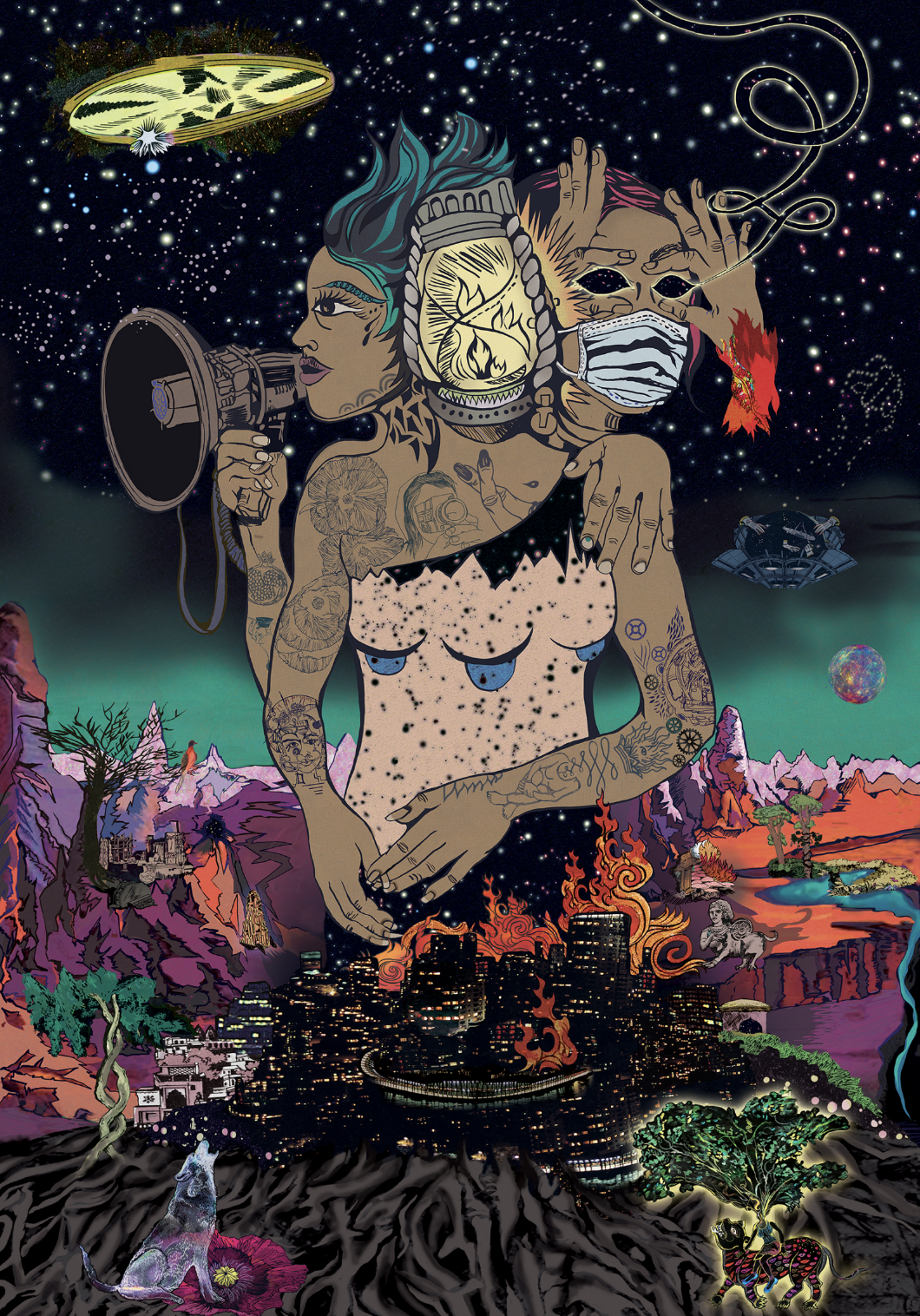
MultiverseDreaming: Urgency, 2020
LIA: When did Aljira first come into your life, and what drew you to tell its story as a young curator who wasn’t a part of its history?
ALLIYAH: Wow, what a great question to start. There are different points I could talk about, but I think the most important for me is growing up in Newark and understanding Aljira.
Going to galleries and museums was not part of our home practice. It wasn’t something my family could afford to do. We are a working-class family, and my parents were often working. When I discovered this new world of arts, exhibitions, museum-going, and gallery-hopping, that came much later in my life. It’s not something I grew up with in Newark, but I always grew up with an appreciation for art and culture.
I went to undergrad at Haverford, and I started learning about art history and the role of public art in museums. I have this very distinct memory of coming home one break and just wanting to go see art, but not being able to afford to go to New York and do the whole museum day, where you get lunch and coffee and all the things. I was like, “I have no money. I just want to go see work.” I Googled what was going on in Newark, very randomly, and I stumbled across Aljira, just frolicking in the city and finding things to do for myself. It was really exciting. I could go in for free, and I was exposed to this alternative art space that felt very ingrained in the community.
Back then, I didn’t really know many people, because I was an undergrad and only home visiting for short periods of time. After I graduated and started working in the city, I saw that Aljira was fading away just as I was coming into my own practice. You start meeting all of these different artists, and they keep mentioning these touch points with Aljira: having projects there, being in community there, or how it inspired another space to open or another collective to gather. It’s something you always read about and always hear about. But this project afforded me the opportunity, as a curator, to get to know it on a deeper level, one that probably isn’t given to us because of how quickly the institution closed and faltered from public space. Not in its memory, but in its physical, material presence in the community.
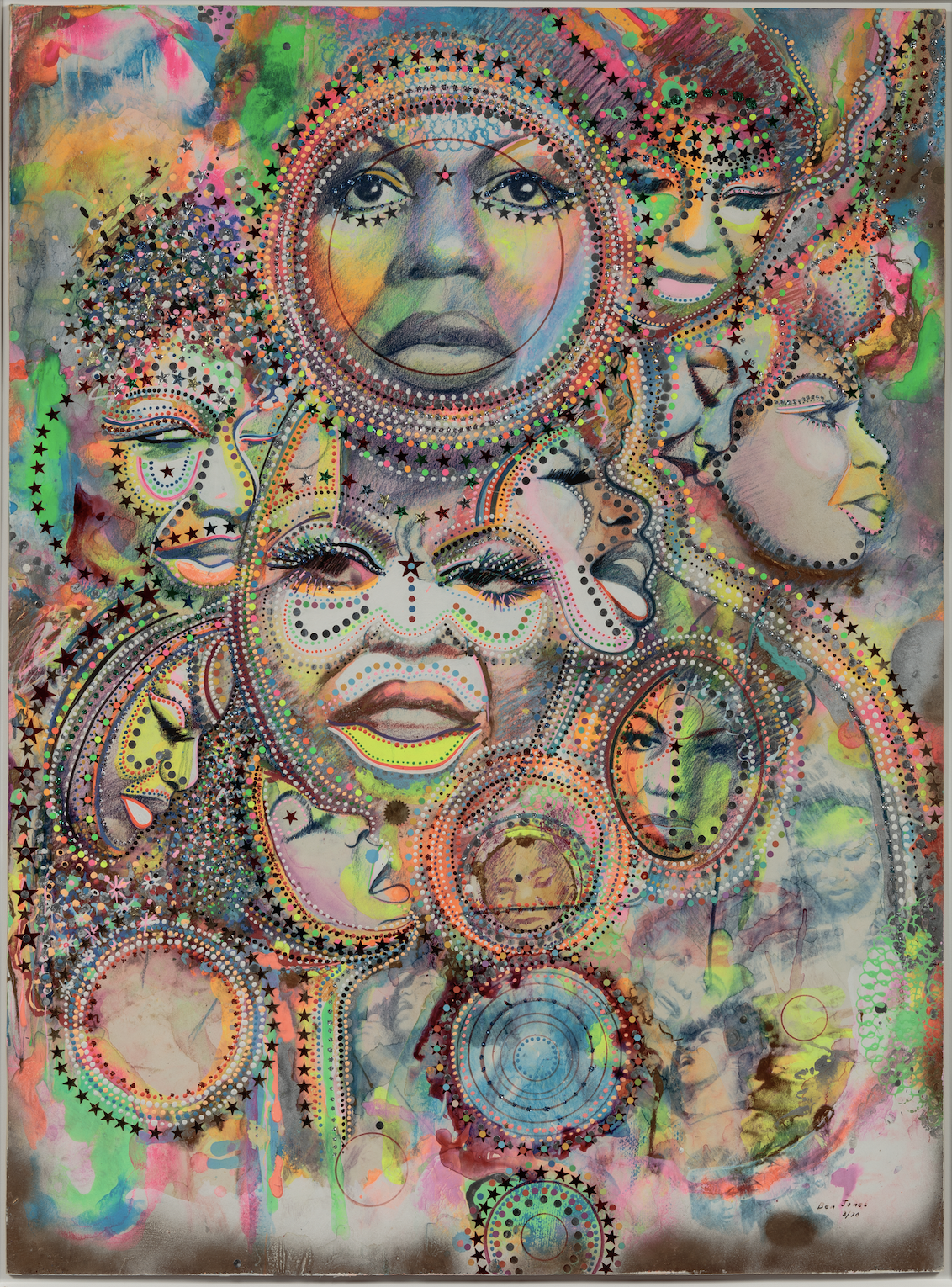
High Priestess of Soul, 1970
LIA: You frame Aljira through Robin D. G. Kelley’s idea of the Black radical imagination, and Kellie Jones’s history of artist-built spaces after Watts. How do those thinkers shape the way you’ve mapped Aljira’s 35 years?
ALLIYAH: I worry sometimes that these critical points in our history get lost. I think that’s a larger intervention I was trying to make: these places are part of this intellectual history, and people are talking about them. But we are in Newark, and sometimes we’re overshadowed by New York, or by the racial and economic factors that make people not see it as a place where these things are happening. I’m really grateful for these texts, which I think of as core texts in my curatorial practice.
I studied with Kellie Jones at Columbia during my master’s program, and what she was doing in South of Pico, tracing these spaces in the aftermath of the Watts Rebellion, felt really similar to what was happening in Newark. Maybe not in the same year, but in the same vein. It’s this energy artists have: they want to create their own establishments in the aftermath of destruction, and resistance, and rebellion, and all the things that come with it. I think her essay is pivotal for understanding this, because there was a narrative emerging after the Newark Rebellion of ’67 that it was just riots and destruction, and that these kinds of establishments could not exist because of all the corruption and things that ensued. But what you do see is this legacy of places opening. It’s not just Aljira. Aljira is the one that did it the longest, with a 35-year tenure. Victor and Carl are working alongside people like Amiri Baraka, who’s doing Spirit House and thinking about theater and about public space that way. Or Gladys Barker Grauer, making Aard Studio Gallery, or the formation of City Without Walls. All of these places are coming together, and I think art is the throughline: that enterprise of saying, “There are no spaces for us to exist and do this work, so we’re just going to create them ourselves.”
Especially when society is turning its back on what’s possible in Newark, Aljira was pivotal in underscoring radical possibility in the face of that. And then, thinking about Robin D. G. Kelley and the Black radical imagination: these artists are part of the avant-garde, and there’s really no denying that, especially given Victor and Carl’s postcolonial identities and their reckonings with the moment they migrated to the U.S. and landed in Newark. I really wanted to draw out that connection. I’ll start with Carl. He comes to the U.S. and lands in Houston first. I wish I had more space to write about this in the catalog, because it’s such a fascinating story.
He lands in Houston because he needs open-heart surgery. In Guyana, he has this condition, and his mother is looking for doctors to operate on him, but no one will accept him. This is the early 1960s, so you have to think about all of the racism that came with that in medicine, and who doctors were willing to operate on. But she finds this doctor, and she starts working at Texas Southern University, an HBCU. Carl is not only able to get the surgery, he’s exposed to this really radical space in Texas during the rise and height of the civil rights movement. He’s painting at 16, 17 years old. The head of the art department at TSU is John Biggers, a very famous muralist and a very iconic figure. What does it mean for Carl to be exposed to someone like him, to get this informal training just by being in community? It radicalizes him. In his early works you see traces of the civil rights movement, Dr. King and the other figures of that moment in the U.S. But you also have his departure from Guyana at the height of its fight for independence, which it declared in 1966.
I think these are all coming together, and that’s what I think Robin D. G. Kelley is talking about: how they’re creating art at the height of all of this. What does that imagination do? What does that world-making do? And the same with Victor. If Carl was the curatorial and artistic heartbeat in the establishment of Aljira, Victor really made it its own space and its own institution. He lands in Newark, and he’s the manager of a liquor store. He has all these odd jobs, but he’s thinking about how to run a space, how to sustain a space and claim it as his own. If you put these two things together and look at the mixing of all these different influences, you’ll see a trend happening across the board with a lot of these spaces, and I think Aljira was really spot on in championing what that possibility meant.
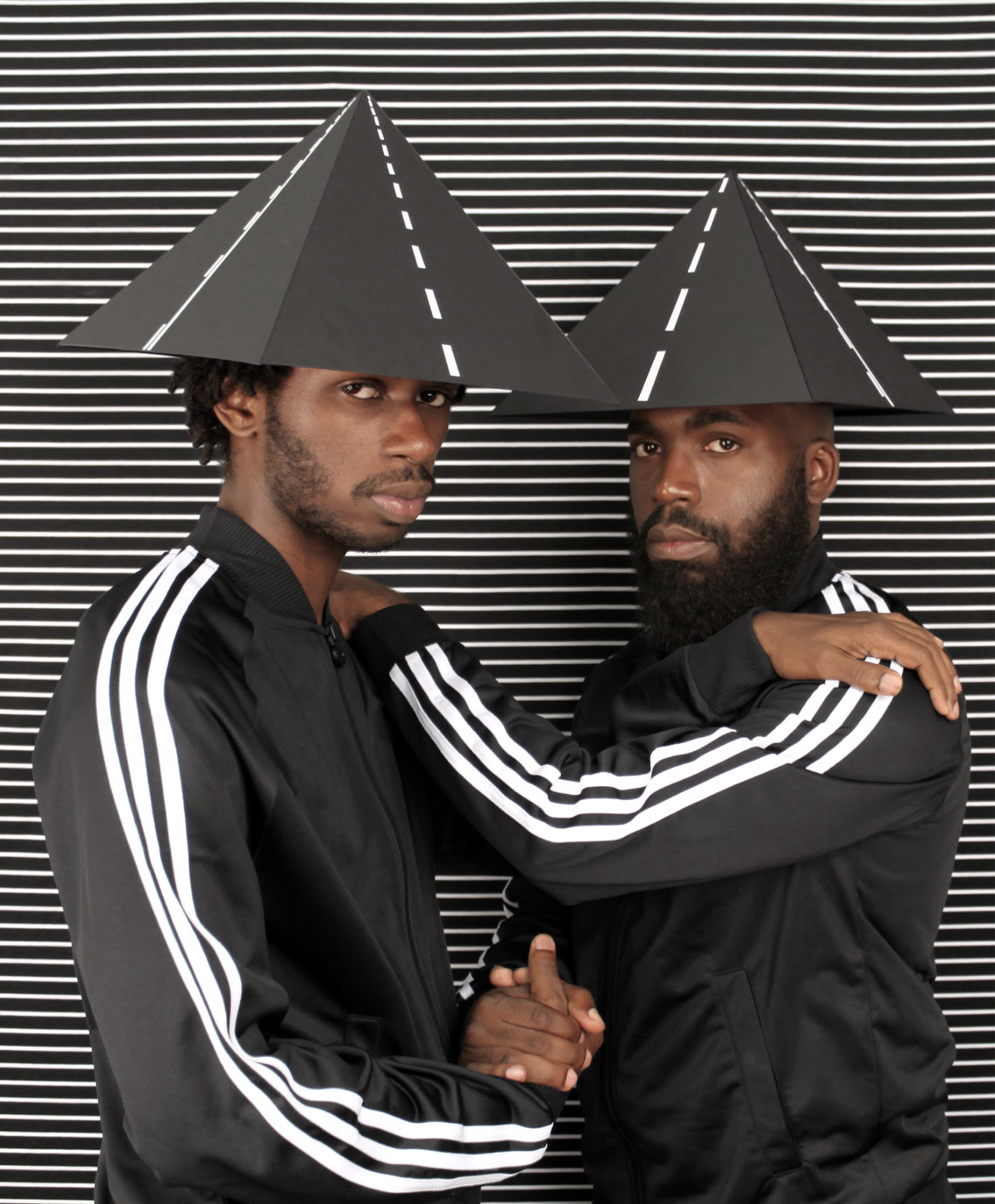
Crossroads, 2012
LIA: Photography and documentation run through the whole show, from Manuel Acevedo and Adama Delphine Fawundu to Andy Brown’s image of Jayson Keeling’s Marked Man. How did lens-based work help you bring Aljira back to life as a social space, not just a gallery?
ALLIYAH: I’ll start with Manuel Acevedo, and Delphine too. Using image-based, lens-based practices as a means of experimentation is so key to what these artists are doing, and Aljira was a space to champion that energy.
For Manuel, there’s his image Rising, which is incredible, because he’s transposing different images onto each other: a scan of the mask of Pedro Albizu Campos, a prominent figure in the Puerto Rican independence struggle, along with a landscape of Puerto Rico. You see it in this surrealist way, where there seems to be decay, but there’s still the natural environment, and then you have this figure rising monumentally within the image. It makes you think about home. It makes you think about Manuel’s identity. He’s from Newark, and he’s Puerto Rican. He was born in Newark and lives in Newark, and his family is from Puerto Rico. He’s grappling with that tension, but he’s doing it in an experimental way, through the photograph. And again, Aljira was a space that really welcomed and championed that.
The same with Adama Delphine Fawundu’s work. What’s so exciting is that we were able to commission a piece from her as well, centered on Willie Cole, who’s another very prominent figure in New Jersey and globally. She takes her images and creates new patterns with them, new ways of seeing. The method is called kpoto patchwork. Her family is from Sierra Leone, but she was born and raised in Brooklyn and has her studio in Newark. Even in the image we include in the gallery, The African Dream? Bamako, Mali, she’s experimenting with these forms and creating new ways of seeing. She made it in 2014, and it’s a shift from her early photographs, where she was photographing women in hip-hop and street culture. Now she’s placing herself as the subject and creating new landscapes, interior landscapes and exterior landscapes. She’s sitting, she’s standing, she’s the central subject, and she’s placing herself in this dreamlike space. There’s so much experimenting happening, and I think that speaks to the accessibility of photography for these artists. But it also speaks to having the space, and that idea of radical possibility: what can the image do? How can it challenge what we know, but also offer new ways of seeing? These artists did that over and over and over again.
Then the Jayson Keeling, and Andy Brown’s image of it. That’s a really important tie to one of the other things this show is trying to do, which is celebrating the history and the legacy of these places, and asking how we remember. Not only how do we experiment and how do we create, but also the legacy. Jayson Keeling’s The Marked Man was actually a performance that happened outside Aljira’s gallery, in the front, at 591 Broad Street. You have people throwing paint, glitter, all of these different materials onto this man, Jayson Keeling, and it’s an embodied performance of queerness, Blackness, all of these different identities confronting themselves in public space. The film is beautiful. I have to shout out our curatorial assistant, Monisha Bernard, because it was really difficult to find a good, high-res version of this film, which speaks to the archive and how fragile it can be. In the reflection, you see the city, but you also see this man dealing with this really interesting tension. They decided to film it and make a photo of it, so it was meant to not be a fleeting thing. The performance was meant to live in our memory and to be rediscovered, and that’s essentially what the show is doing through its creative networking and the different mediums we’re choosing. I think it’s all there: Photography and image-making ground the show in so many different ways.
LIA: You highlight The B Sides and Aljira’s support of Black queer diasporic artists at a time when that support was rare. Why was it important to put that chapter in the foreground?
ALLIYAH: Why was that important? For a number of reasons. I was talking about this the other day: something this show, and going back into Aljira’s histories and archives, has taught me is the meaning of care, and I’m understanding that on new levels. As a Black feminist, I’ve always tried to center care in my practice, but what is so telling about this project is that you see care as something they don’t compromise on. They created not just a space to exhibit marginalized artists, but a space for artists to come into community as their full selves. I think that’s key to transforming a gallery space into a ballroom. And this was before we were doing it today. If you look at practices today, galleries champion this idea, but they were ahead of their time in that sense. I think it speaks to the curators and the artists they had.
For example, Edwin Ramoran curated that show, and he was part of the queer community. What does it mean to champion curators too? What new perspectives and lenses does that bring for community? What does it mean to create a home? I think that’s what the last section of the essay is trying to do: centralize this idea of home, especially when the museum is turning you away or not focusing on these aspects of our culture. What does it mean to create that in a space where it might be lacking?
What I think is so interesting about The B Sides, and I didn’t even get to talk about this, is that Simone Leigh was in that show. I think Rashaad Newsome was also on the list of artists. So again, what was attracting these global, massive artists to Newark, New Jersey, to this space at 591 Broad Street? Positioning visual art against ballroom culture: the juxtaposition of all of that is important too. There are some really interesting photographs and pieces in that show, and I’m only seeing it through glimpses of the archive. I wasn’t there to experience it in person, so I’m only looking at what the flyer can tell me, what the archive can tell me. But again, it’s the centralizing of community that I think is so key, with art as the heartbeat, the way to go through it.
LIA: Hazlewood says, “It is a very difficult situation right now for nonprofits.” What do you hope young artists, curators, and publishers building their own spaces take away from Dreamtime in Newark?
ALLIYAH: I feel like it’s so important. I’m so excited that we’re even sitting down with your publication, because, and Dawoud Bey writes about this in his essay, there’s that concept of “do for self,” do it yourself. I think that is what you have to take away, especially in the times that we’re in. I was just talking to a friend about how all the funding in the arts is being pulled, and these attacks on DEI. We’re so focused on what’s happening in the mainstream spaces, and I’m not saying don’t pay attention to that. But when you look toward the alternative space, toward these independent establishments, like Kellie Jones points out in her essay, what you see is world-making happening on a whole different level, one that transcends the limits and restrictions these other spaces impose. You need to look toward your publication, you need to look toward places like Aljira, because they are the ones doing the work that would otherwise go unnoticed. And if you pay attention, what you start seeing is that the mainstream does take notice.
That’s why I think Frank Bowling is so pivotal in this celebration and remembering of Aljira. Aljira gives him his first retrospective in 2003, but this man has been a prominent abstract expressionist for years, still not getting his due. His work isn’t acquired by the Tate until much later. He’s been creating these massive, beautiful works for years, and who’s recognizing that labor? Who’s recognizing that impact? It’s not the canon. The canon doesn’t get it right all the time, so the alternative is where worlds are being reimagined, and where I think real learning, real truth, and meaning-making are happening. I can’t stress that enough. But I also understand the danger in that, because it’s easier for these spaces to be erased, to not be recognized. And that’s something else we tried to highlight with this show: The Newark Museum of Art’s commitment to championing Aljira and to always being in community with it. Not hierarchical, but next to it, saying, “Okay, you’re doing this show? We’ll do it too.” Now, on the record, it’s The Newark Museum of Art and Aljira presenting. What does it mean for an alternative art space to be recognized by an institution? It’s so transformative. You still look at certain CVs, and this is what Dawoud Bey talks about, and Aljira starts getting erased from these artists’ histories, because people don’t think it’s important or recognizable. But it is, because that is where the work is happening. It’s our job, in these independent, alternative spaces, to do that work and to highlight that history, even as we’re still making it and producing it.