The Archive Is Not Fixed: Inside “Tomorrow the Sun Will Rise”
By Lia J. Latty
Published: August 7, 2026
Juror in Conversation: Tsedaye Makonnen on Shaping Tomorrow the Sun Will Rise
Without a set theme guiding submissions, the one defining parameter was that work had to be made after November 2024. How do you think a show like this would have looked if curated in 2016 instead?
TSEDAYE: I think it would have been similar for several of the artists who would have submitted during the 2016 election year. Many of the local, national, and global crises we are facing now existed and were prevalent in 2016 as well. If anything, what has changed since then and now is that we have become more aware of how connected we are locally and globally. Personal social media accounts have taken a more prominent role in televising how unjust our world is and how many of us have been indoctrinated into thinking that we are more separate than connected. From state-sanctioned and state-sponsored violence against Black Americans and immigrants here in the U.S. to the erasure and displacement of Indigenous peoples across the Americas and abroad, to the several genocides happening in Palestine, Congo, Sudan, Ethiopia, the Amazon…to the perilous migration routes the Global South risk to seek refuge in the very countries that have extracted/depleted/pillaged/colonized their lands and people over several centuries, to the majority of the world (including the United States) who live under a caste system that only benefits the 1%, to those kidnapped, severed from their children and held hostage in ICE prisons…
I don’t think we would have gotten less politically charged submissions in 2016 because many of the themes that the artists are exploring have existed and impacted their communities long before any of these recent elections. I think the difference between 2016 and 2024 is the audience and the institutions; they can no longer look away. We are living through an era that is becoming harder to ignore or whitewash.
The meaning of Sankofa comes to mind, an Akan word (Ghanaian origin), “to go back and get it”, essentially learning from the past to guide the future. As Nina Simone said: it is the artist’s duty to reflect the times.
The show is framed around DC as inherently global. Your own work moves between Ethiopia, DC, and London. How did that shape what you were looking for during the jurying process?
TSEDAYE: Well for one, growing up in the DMV lent itself to having a very diverse childhood with friends, teachers and community members from all over the world. So I was not surprised to see that many of the artists we selected were not only Americans but also had other countries of origin. As an artist I am DC-based but consider myself a global artist, I am not limited to any fabricated border and as you pointed out I have not only lived abroad but have exhibited internationally for several years. So much of my work is site-specific to the land I am working on and is diaspora-focused, connecting kin communities that have been intentionally kept apart. I do rep DC culturally as someone who was born here and grew up around here. I was raised by Ethiopian immigrants who made it very clear to me that the Black Americans of D.C. are the reason they and other immigrant populations in the DMV settled here (whether they are aware of that or not). The Civil Rights movement made it possible for those not born here to move here, and the hospitality and labor of Black D.C. natives made it an easier transition for so many who now call the DMV their home.
Given that this is the nation’s capital, it only makes sense that this show reflects that diversity which also happens to be very international.
A mantra that came out of this exhibition is: D.C. is not only local but a global city as well.
What do you want each viewer to walk away with knowing about the power of art-making speaking to lived experience?
TSEDAYE: I hope that this exhibition expands any narrow views the audience may have when encountering the worlds these artists have built through their work and that this leads to positive, meaningful action that dissolves the supremacies and fascism that exist within each individual. I also want the viewer to be blown away by the labor and mastery that many of the artists in this show are exhibiting through their work.
Another point I want the viewer to walk away with is that the immigrants who live within these fabricated borders called the United States (originally known as Turtle Island) are American too.
And finally, that DMV artists deserve to be invested in, deserve to be uplifted and platformed by the major institutions that are right here. The D.C. art scene is rich, complex, and rigorous, and in my opinion, deserves way more intentional investment from the city, the institutions, collectors, patrons, businesses, and so on.
We are living through an era that is becoming harder to ignore or whitewash.
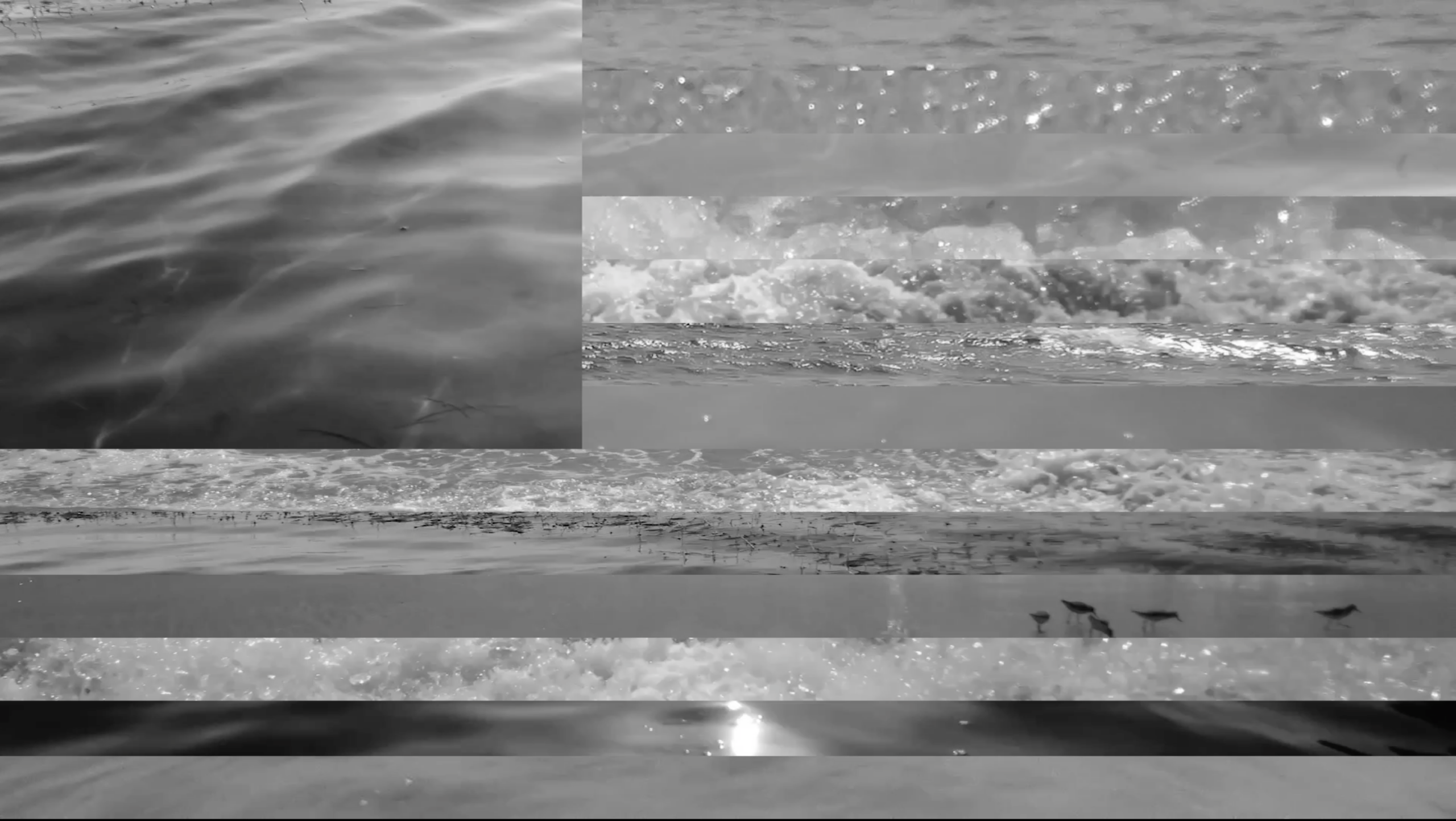
Middle Passage / Ocean Flag, 2025.
Archiving the Personal: In Conversation with the Artists
Savannah Faith Jackson
Photography has a colonial history you’re working against by using it. Does that tension sit differently for you when the subject is the ocean instead of a person?
SAVANNAH: For as long as photography has been used as a tool for colonialism, it has been used as a tool for justice. Frederick Douglas was the most photographed person of the 19th century. Having himself photographed as much as possible was an integral tactic in his fight for abolition, and he began doing so very shortly after the invention of photography. So I wouldn’t say I’m working against a colonial history of photography; I would say I’m working in the liberatory tradition of photography. Like photography, the Atlantic Ocean has this double history in that it is the Middle Passage–a site of dehumanization and atrocity–but also the water that’s believed to bring African Americans to freedom(spiritually). There’s an Imani Perry quote I often think about: “Hell was the bottom of the ocean floor until it became salvation.” All this is to say that I feel a similar responsibility to represent nuance when photographing the ocean that I feel when photographing people.
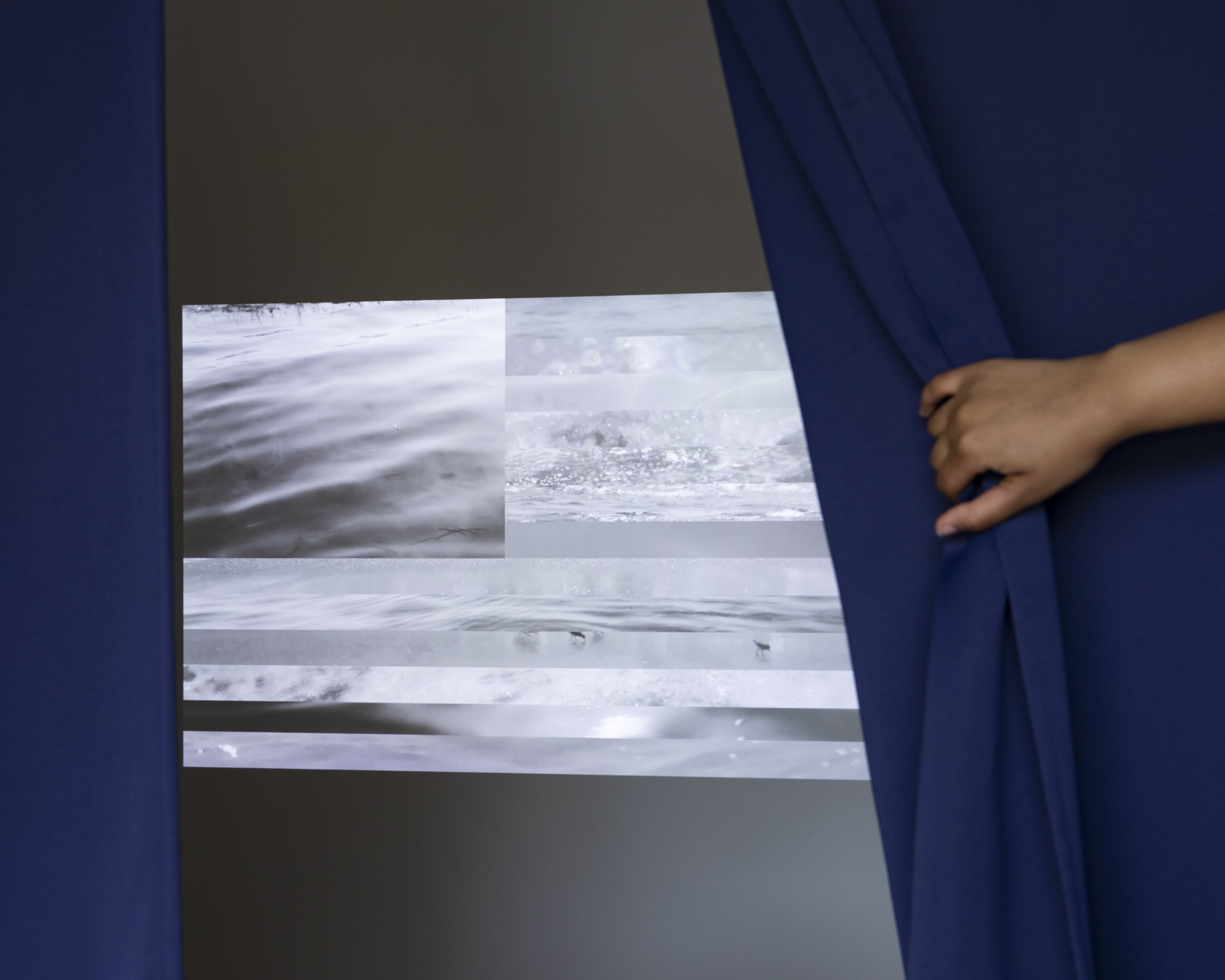
With your use of indigo curtains, was there a point where the material almost overwhelmed the footage where you had to balance the two?
SAVANNAH: I think that, when working in installation, if anything it’s hard to not let the bright, literally glowing, digital element overpower the analog elements.
Archiving implies something is being kept for later. Who do you imagine on the other end of that, who is this record actually for?
SAVANNAH: I don’t think I’m really archiving anything these days. Recently I work in a lot of natural materials–indigo, cotton, etc.– these things are inherently non-archival. I understand why archives are important, especially for Black Americans, but that’s more the work I feel compelled to do right now. I was raised on oral history and storytelling. Right now, I’m particularly intrigued by archives that aren’t tangible, that live through people and intergenerational conversation.
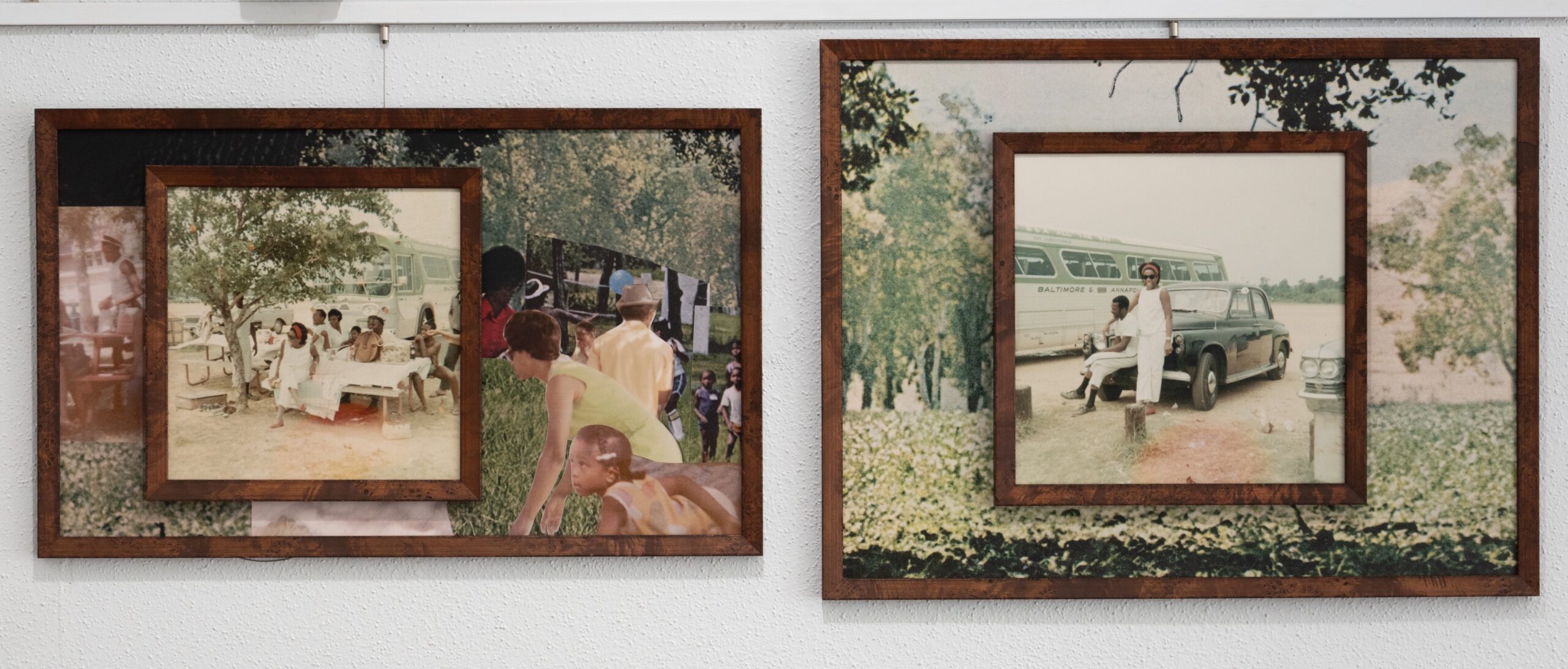
The Get Together, 2025.
Bria Sterling-Wilson
Your work often starts with found or family photographs before you cut into them. What has to be true of an image before you’re willing to alter it?
BRIA: There has to be a story that I want to tell. Something about the image has to speak to me in a way that I feel others will understand or relate to. I believe art builds understanding and creates connections between people, so it’s meaningful when the work can do that through storytelling and imagery.
This piece comes out of watching your grandmother age. Was the decision to blend real family photographs with found imagery a way to protect her, or a way to widen the story beyond just her?
BRIA: Found imagery has always been an essential part of my practice. I use it to widen the story and add layers of meaning that go beyond a single person or experience. While the work is rooted in my grandmother’s life, the found images allow the piece to speak to broader themes of memory, aging, caregiving, and Black family life. They create connections between personal history and collective experience.
Archiving implies something is being kept for later. Who do you imagine on the other end of that, who is this record actually for?
BRIA: My work is for the next generation. I want it to exist in history books, magazines, publications, museums, and educational institutions so that it continues to live on in many forms. I’ve always wanted my work to serve as a form of preservation for my family and for Black life. It’s important to me that these stories remain visible, remembered, and accessible long after I’m gone.
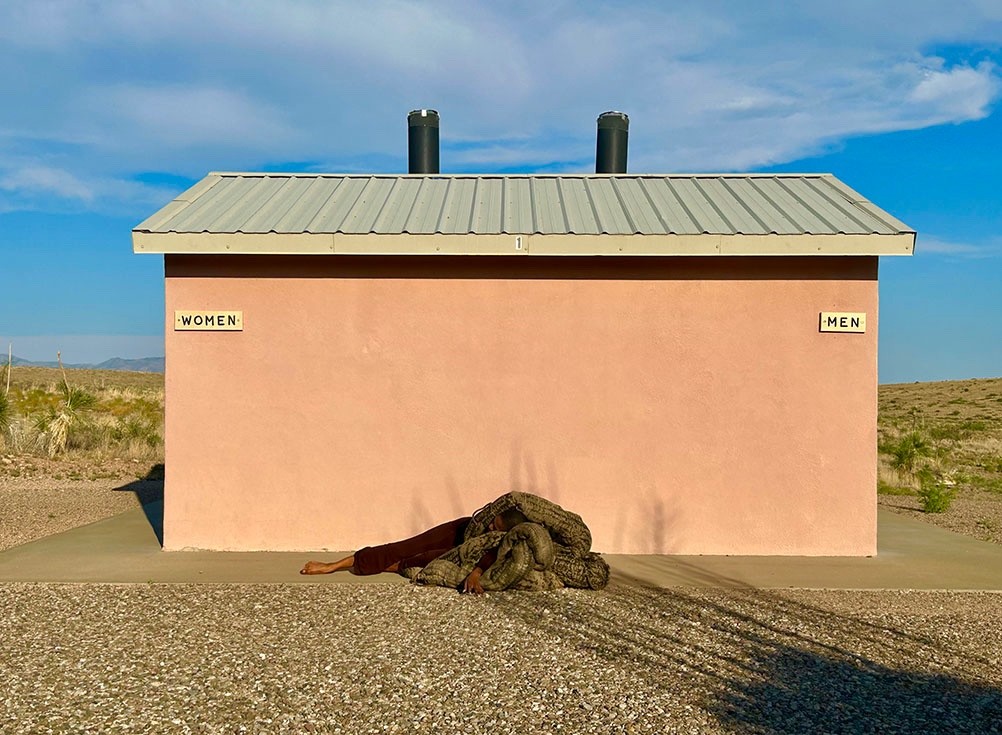
Made in Crossroads: (Be) coming One, 2025.
Melissa Sutherland Moss
Crossing Point is described as a threshold marking passage and pause. Does the piece in this show read to you as a passage or a pause, or does it hold both at once?
MELISSA: The work holds passage and pause at the same time. Made in Crossroads: (Be)coming One comes from movement between Jamaica, Costa Rica, and the United States, but also between inherited history and my own lived experience. Making the work allows me to pause within that movement and consider what has been carried forward. The pause is also a moment of listening, gathering, and understanding who I am before continuing again.
It is also about learning to hold all of my identities together rather than separating them or bringing forward only the parts that feel convenient, acceptable, or appropriate for a particular space. “Becoming one” does not mean that those identities lose their differences. It means allowing them to coexist as parts of one whole self.
Your body moves through this work as both a performative site and something navigating displacement and erasure. Is there a difference for you between being seen and being perceived, and does the work resolve that tension or just sit inside it?
MELISSA: There is a difference for me between being seen and being perceived. Part of the work is investigating the boundary between performance and daily life. I explore how existing within Western landscapes challenges my notions of belonging, connection, and ‘home.’ To be seen suggests being recognized in the fullness of who I am. To be perceived means that someone may be looking at me through their own assumptions about race, gender, nationality, migration, or where they think I belong.
Although displacement and erasure are present in the history behind the work, I don’t want my body to exist only in relation to those conditions. I want it to be able to move toward comfort, safety, freedom, and rest even as I remain uncertain about where those things can be found.
I don’t think the work resolves the tension between being seen and being perceived. It stays inside that space. But it also gives me some control over how my body enters the image, how it moves, what it reveals, and what it keeps for itself.
Archiving implies something is being kept for later. Who do you imagine on the other end of that, who is this record actually for?
MELISSA: I imagine this record reaching people who may one day be searching for themselves within histories that were never fully preserved. That might include my family, future generations, or other people connected to Afro Latinx-Caribbean migration whose histories have been fragmented, overlooked, or carried primarily through memory.
The archive is also for me. Making the work allows me to hold onto what I am learning while acknowledging what I may never completely know. I’m not trying to create one definitive record. I’m leaving evidence of the search, all the information I have inherited, what I encountered, and how I understood belonging at this particular point in my life.